South Korea has officially launched its permanent visa program for location-independent professionals worldwide. With ultra-fast gigabit internet, high public safety, rich cultural heritage, and exceptional quality of life, more remote workers are searching for the best ways to obtain a digital nomad visa south korea.
If you plan to live and work remotely in East Asia, securing the F-1-D Workation Visa in South Korea provides the perfect legal pathway. Below is a comprehensive, step-by-step guide covering everything from income eligibility and required documents to the essential tech ecosystem you need for daily life in Seoul.
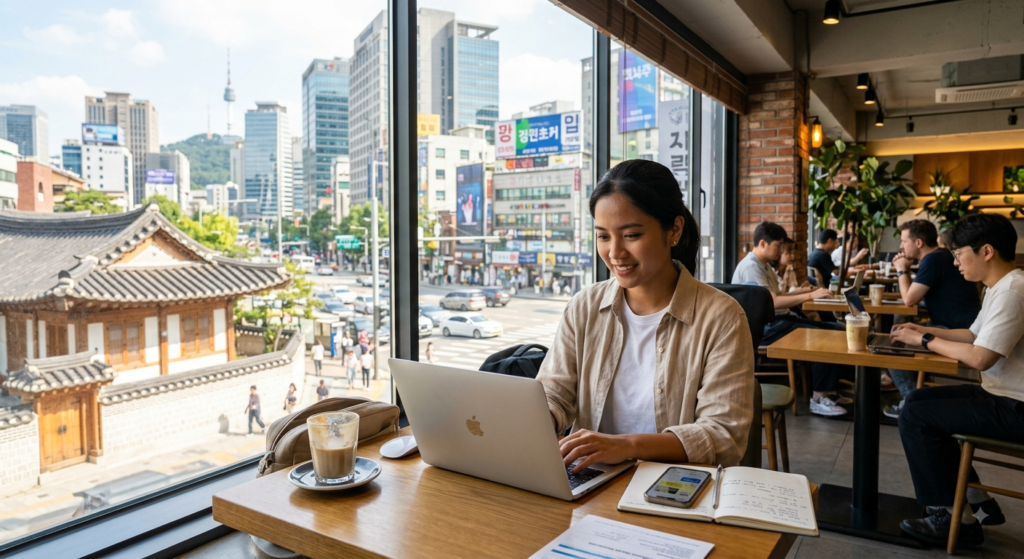
Part 1: What Is the Digital Nomad Visa South Korea (F-1-D Visa)?
The official digital nomad visa south korea, formally designated as the F-1-D Workation Visa, allows qualified foreigners to reside legally in the country while maintaining foreign remote employment. Launched to support remote professionals, freelancers, and global company employees, this visa enables long-term stays without requiring sponsorship from a domestic Korean company.
Key Benefits of the F-1-D Visa
- Extended Long-Term Residency: You can legally stay in South Korea for up to 3 years through annual extensions.
- Family Inclusion: Spouses and dependent children under 18 can accompany the primary visa holder.
- Multiple Entry Privileges: You can travel in and out of South Korea freely during your valid visa period.
- Simplified In-Country Switch: Tourists and visa-free visitors can apply to convert their status to the digital nomad visa south korea at local immigration offices.
Part 2: Eligibility Criteria and Tiered Income Requirements
To successfully obtain a digital nomad visa south korea, applicants must meet specific employment, income, and background checks established by the Ministry of Justice.
1. Employment and Professional Experience
- You must be employed by an overseas entity or operate an established foreign business.
- Applicants are required to demonstrate at least 1 year of continuous work experience in their current industry.
- Local employment within South Korea is strictly prohibited under this visa status.
2. Tiered Annual Income Threshold
- Standard Requirement (2x GNI): Applicants residing in the Greater Seoul area generally need an annual income equivalent to twice South Korea’s GNI per capita (approx. ₩104.8M+ KRW / ~$76,000 USD).
- Regional & Age Incentives (1x–1.5x GNI): Under updated guidelines, younger remote workers (aged 18–34) or those residing outside metropolitan Seoul qualify for lower income tiers starting at 1x GNI (approx. ₩52.4M+ KRW / ~$38,000 USD).
- Proof of Income: You must submit verified pay stubs, international bank statements, or official tax documents covering the past 3–12 months.
3. Medical Insurance and Background Clearances
- Health Insurance Minimum: Applicants must hold private health insurance with guaranteed coverage of at least ₩100 million KRW (approx. $75,000 USD) for medical treatment and repatriation.
- Criminal Record Clearance: A clear national criminal background check with an official Apostille is required.
Part 3: Essential Tech Setup for Remote Workers in South Korea
Having the right software and connectivity tools is critical when settling in under the digital nomad visa south korea. Due to national security regulations regarding geographic data, international platforms like Google Maps operate with restricted features. Adopting the local tech infrastructure ensures smooth navigation and maximum daily productivity.
| Tech Category | Best App / Local Tool | Why It Is Essential for Remote Workers |
| Navigation & Maps | Naver Map / KakaoMap | Essential for walking routes, public transit schedules, and finding work-friendly cafes with English support. |
| AI Translation | Naver Papago | Superior natural language translation for Korean nuances and camera image translation. |
| Mobile Connectivity | eSIM (KT, SKT, LG U+) | Secures high-speed 5G mobile data immediately upon arrival at Incheon International Airport. |
| Transit & Payments | Climate Card / WOWPASS | Provides unlimited public transport rides or convenient currency exchange and debit card functionality. |
| Co-working Spaces | FastFive / WeWork / Local Cafes | Offers gigabit Wi-Fi, ergonomic workstations, and collaborative communities across Seoul. |
Part 4: Step-by-Step Application Workflow
Following a systematic process when applying for the digital nomad visa south korea prevents unnecessary delays and application rejections.
- Document Gathering: Collect 3–6 months of foreign pay stubs, income tax returns, foreign employment contracts, and an apostilled criminal record check.
- Insurance Purchase: Secure an international medical policy meeting the ₩100 million KRW minimum coverage requirement before filing.
- Application Submission: Submit your completed documentation to the nearest Korean Embassy/Consulate in your home country, or apply via HiKorea if converting status locally.
- Residence Card Registration: Upon arrival, register for your Residence Card at a local immigration office within 90 days to unlock local banking and mobile services.
Summary: Is South Korea Worth It for Remote Workers?
Securing a digital nomad visa south korea unlocks direct access to world-class modern infrastructure, incredible food culture, and hyper-connected cities. By fulfilling the eligible income threshold and setting up the local app ecosystem, you can enjoy a seamless lifestyle in one of Asia’s premier innovation hubs. innovation hubs.