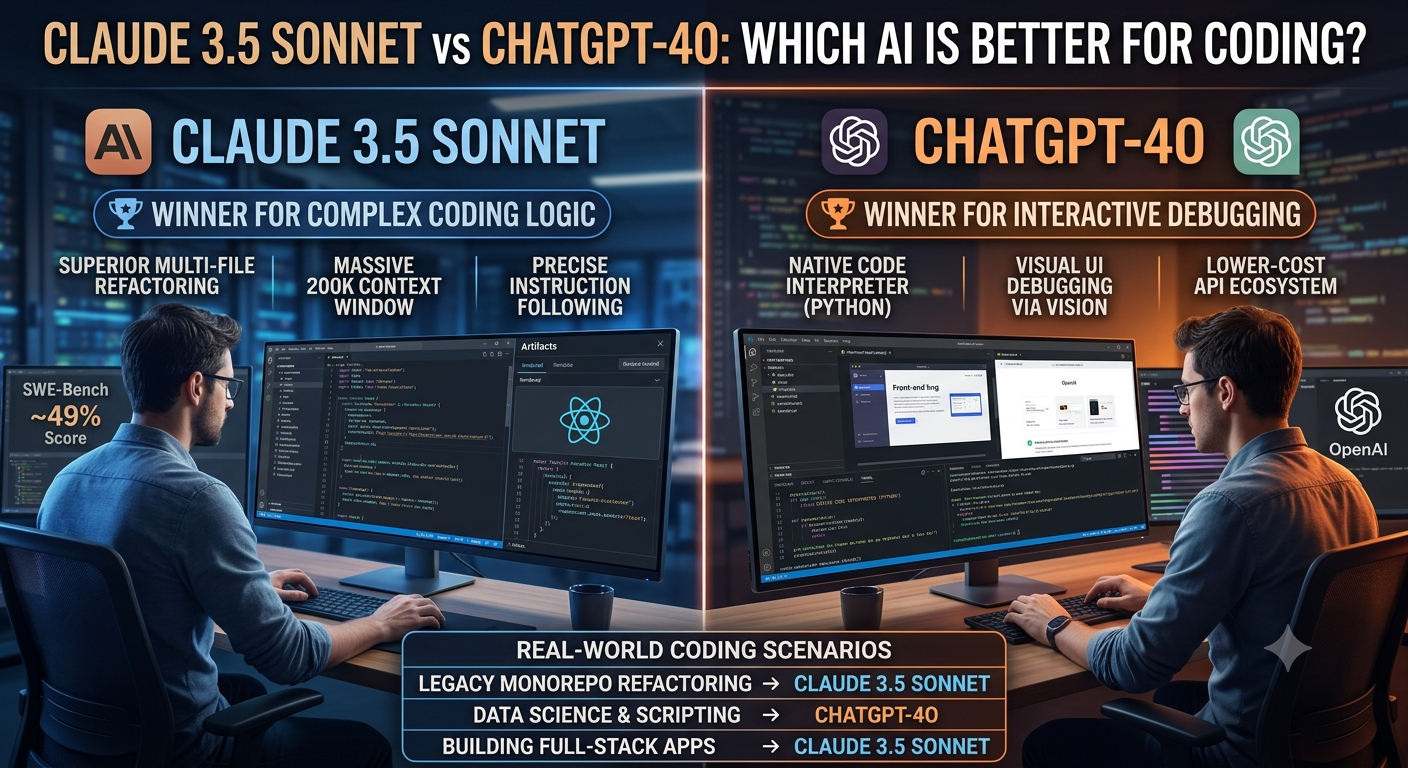
Artificial Intelligence has transformed software engineering, with developers relying heavily on Large Language Models (LLMs) to write, debug, and refactor code. When choosing the best tool, the Claude 3.5 Sonnet vs ChatGPT-4o comparison remains a central debate among modern developers.
While both tools promise faster coding workflows, they approach code generation differently. Is Claude 3.5 Sonnet’s massive context window superior for large codebases, or does ChatGPT-4o’s Code Interpreter and multimodal capabilities make it the better overall daily driver?
In this comprehensive guide on Claude 3.5 Sonnet vs ChatGPT-4o, we evaluate benchmark performance, context limits, multi-file refactoring, debugging capabilities, and pricing to help you choose the ideal AI coding assistant.
Quick Summary: Claude 3.5 Sonnet vs ChatGPT-4o Verdict
If you need a quick decision based on real-world engineering workflows:
- Choose Claude 3.5 Sonnet if you work with existing, large-scale codebases, require precise instruction-following, or need to generate complex full-stack web application code.
- Choose ChatGPT-4o if you require interactive visual debugging (e.g., uploading UI screenshots or error logs), real-time data analysis via Code Interpreter, or lower API token costs for high-volume pipelines.
Claude 3.5 Sonnet vs ChatGPT-4o: Core Features Comparison
To understand how these two flagship AI models stack up, let’s examine their technical specifications and real-world performance metrics side-by-side.
| Feature / Benchmark | Claude 3.5 Sonnet | ChatGPT-4o | Winner |
| Context Window | 200,000 Tokens (~150K words) | 128,000 Tokens (~90K words) | Claude 3.5 Sonnet |
| SWE-Bench Verified Score | ~49.0% | ~38.0% | Claude 3.5 Sonnet |
| HumanEval Pass@1 | 92.0% | 90.2% | Claude 3.5 Sonnet (Tie) |
| Code Execution (Sandboxed) | Via UI Artifacts / API Extensions | Built-in Code Interpreter (Python) | ChatGPT-4o |
| Multimodal Debugging | Image/Doc input supported | Advanced vision + UI screenshot debugging | ChatGPT-4o |
| API Pricing (Input / Output) | $3.00 / $15.00 per 1M tokens | $2.50 / $10.00 per 1M tokens | ChatGPT-4o |
Deep Dive: Where Claude 3.5 Sonnet Excels
1. Superior Code Logic and SWE-Bench Leadership
When evaluating real-world software engineering tasks—such as fixing bugs in complex GitHub repositories—Claude 3.5 Sonnet consistently leads ChatGPT-4o. Achieving a ~49% score on SWE-Bench Verified compared to GPT-4o’s 38%, Claude displays a deeper understanding of multi-file dependency structures and logic flow.
2. Massive 200K Context Window & “Artifacts” Feature
Claude’s 200,000-token context window allows developers to upload entire documentation libraries, framework references, or massive monorepos in a single prompt.
Furthermore, Anthropic’s Artifacts feature opens a side-by-side interactive window where developers can render full React components, SVG diagrams, or web UI code live in the browser alongside the chat interface.
3. High Fidelity to Complex Prompt Instructions
One major advantage reported by software engineers in the Claude 3.5 Sonnet vs ChatGPT-4o match-up is Claude’s adherence to long system prompts. It follows strict formatting requirements, naming conventions, and edge-case parameters without ignoring system rules over long context threads.
Deep Dive: Where ChatGPT-4o Excels
1. Native Code Interpreter & Environment Sandbox
ChatGPT-4o features an integrated Code Interpreter environment. Rather than simply writing code and asking you to test it locally, ChatGPT can run Python scripts in a sandboxed runtime, process uploaded files, debug runtime exceptions automatically, and output downloadable CSVs or generated graphs.
2. Visual Debugging and Multimodal Workflows
Thanks to advanced vision capabilities, ChatGPT-4o is exceptional for front-end developers. You can upload a design mockup or take a screenshot of a broken UI/console error, and GPT-4o will identify alignment issues, DOM bugs, or missing CSS rules with precision.
3. Ecosystem Integration and Cost Efficiency
OpenAI models remain widely supported across mainstream AI developer platforms, including GitHub Copilot and Cursor IDE. Additionally, for developers using the API directly, GPT-4o offers a cheaper price point per million input/output tokens compared to Sonnet, making it cost-effective for automated background pipelines.
💡 Related Reading: Trying to optimize your team’s development budget? Check out our guide on Top 5 Free Open-Source AI Tools to Reduce Enterprise SaaS Costs (2026) to discover self-hosted alternatives that eliminate proprietary API fees.
Real-World Coding Scenarios: Which AI Should You Use?
Scenario A: Refactoring a Legacy Monorepo
- Winner: Claude 3.5 Sonnet
- Why: Claude’s 200K context capacity and lower hallucination rate make it better at holding thousands of lines of code in memory without breaking dependencies across files.
Scenario B: Data Science, Automation, and Scripting
- Winner: ChatGPT-4o
- Why: OpenAI’s Code Interpreter can load raw JSON, Excel, or CSV files, manipulate them using Pandas, test execution, and refine script errors autonomously before handing you the final code.
Scenario C: Building Full-Stack Web Apps from Scratch
- Winner: Claude 3.5 Sonnet
- Why: The combination of Claude’s context length, clean architectural output, and interactive Artifacts viewer allows developers to build and test frontend components in real-time.
Final Verdict: Claude 3.5 Sonnet vs ChatGPT-4o
When analyzing Claude 3.5 Sonnet vs ChatGPT-4o, both models prove to be industry-leading tools that outperform almost every other LLM on the market. However, the choice ultimately comes down to your primary developer workflow:
For pure code quality, complex reasoning, and working inside large production codebases, Claude 3.5 Sonnet takes the top spot.
On the other hand, if you value interactive execution, visual UI debugging, data analysis, and a lower-cost API ecosystem, ChatGPT-4o remains a versatile and highly capable solution.
Many professional developers now use a hybrid approach: Claude 3.5 Sonnet for architecture design and complex refactoring, and ChatGPT-4o for rapid prototyping, script execution, and API automation.
Frequently Asked Questions (FAQ)
Is Claude 3.5 Sonnet better than ChatGPT-4o for Python?
Both models excel at Python development. However, ChatGPT-4o has an advantage when executing and testing scripts internally, while Claude 3.5 Sonnet is better at writing complex, multi-file object-oriented Python architecture.
Can I use Claude 3.5 Sonnet inside VS Code or Cursor?
Yes, Claude 3.5 Sonnet is supported via API integration in popular AI IDEs like Cursor, Windsurf, and VS Code extensions.
Which AI is cheaper for developers?
For web subscriptions, both Claude Pro and ChatGPT Plus cost $20/month. For API usage, ChatGPT-4o is cheaper per token ($2.50/M input, $10/M output) compared to Claude 3.5 Sonnet ($3.00/M input, $15.00/M output).de 3.5 Sonnet ($3.00/M input, $15.00/M output).