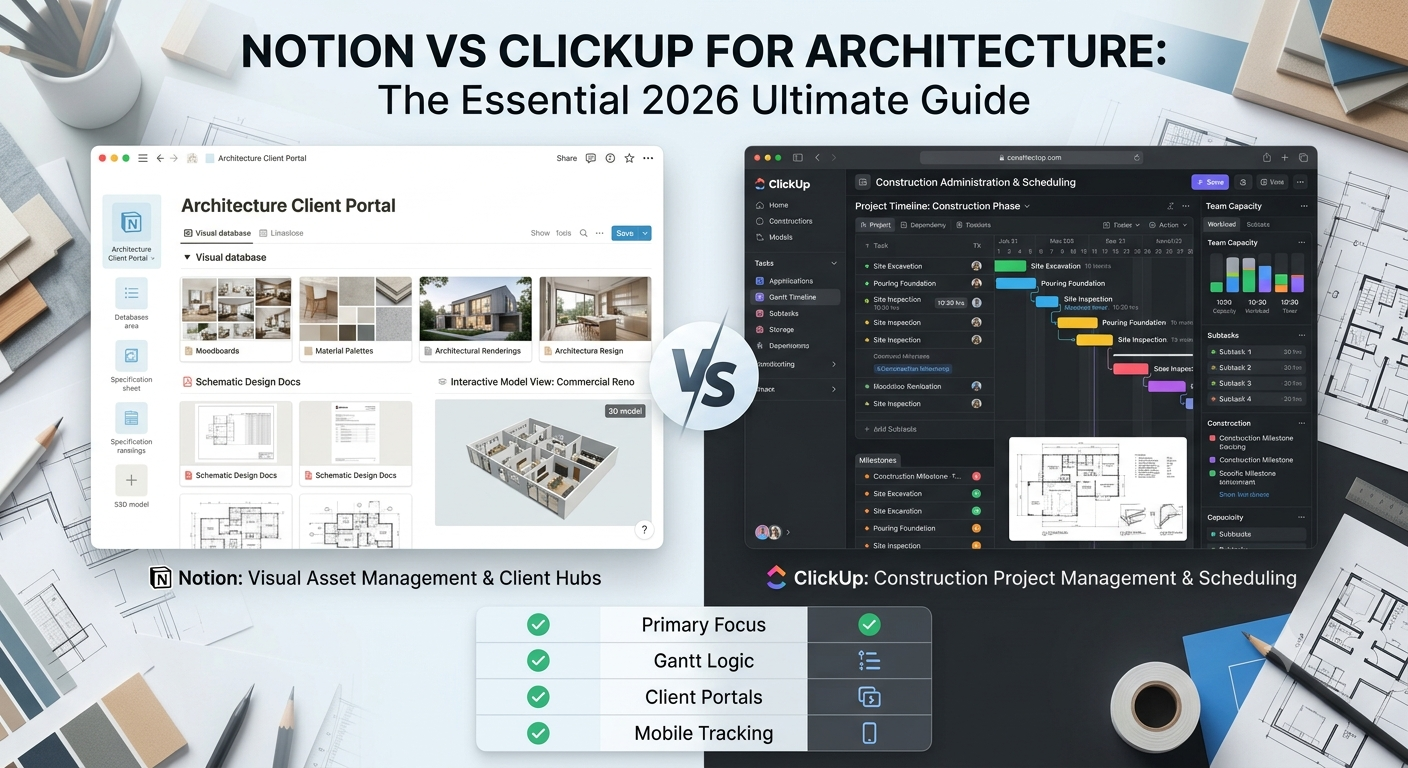
Architectural projects present a unique management challenge. You aren’t just managing simple to-do lists; you are juggling multi-gigabyte CAD files, strict city permit deadlines, material specifications, and client presentations. When analyzing Notion vs ClickUp for architecture, a single breakdown in communication can lead to costly site delays or design misinterpretations.
Over the past two months, our architectural design studio tested both tools on a live commercial renovation project. We migrated our entire workflow to evaluate Notion vs ClickUp for architecture and determine which platform truly supports daily operations in 2026.
Here is our comprehensive, hands-on breakdown to help your firm decide.
1. Asset Management & Client Hubs
The first major consideration when evaluating Notion vs ClickUp for architecture is how each platform handles visual communication. Moodboards, material palettes, and client portals play a massive role in daily operations.
Notion: The Flexible Digital Canvas
Notion operates as a modular, block-based workspace. For our firm, this flexibility proved why many teams prefer Notion vs ClickUp for architecture during the schematic design phase:
- Interactive Client Portals: We created a master page for clients containing embedded 3D models, interactive moodboards, and linked PDF specs.
- Material Spec Databases: Notion’s inline databases allowed us to create a centralized material finish library, tagging suppliers and unit costs.
ClickUp: A Structured Approach
While ClickUp supports file attachments, its document capability acts more as an add-on:
- Task-Centric Files: Attachments are locked inside individual task windows, making it harder to browse visual site specs.
- Client Sharing Limits: Sharing ClickUp boards with non-technical clients often led to confusion due to the dense interface.
2. Construction Scheduling & Gantt Charts
Once a project moves into construction administration, analyzing Notion vs ClickUp for architecture shifts focus toward strict deadline management.
ClickUp: Built for Complex Execution
ClickUp shines when managing sequential construction phases:
- Native Critical Path Gantt Charts: Setting up task dependencies is intuitive. ClickUp automatically shifts downstream deadlines if an earlier milestone is delayed.
- Field Time Tracking: Using ClickUp’s mobile app, our site architects logged exact hours spent on site inspections with native start-stop timers.
Notion: Lightweight Timelines
Notion supports native task dependencies, but falls short for heavy construction logic:
- Limited Cascading Logic: Auto-shifting complex multi-trade schedules remains far less robust than ClickUp’s workflow engine.
- Third-Party Time Tracking: Tracking billable site visit hours requires external integrations like Toggl.
3. Software Integrations & Technical Ecosystem
To get the most out of Notion vs ClickUp for architecture, you must see how they integrate with specialized BIM and CAD software like Autodesk Revit or Rhino. Knowing how each tool handles cloud files is crucial when assessing Notion vs ClickUp for architecture practices.
- Notion Ecosystem: Integrates seamlessly with cloud storage tools like Google Drive or Dropbox, as well as design platforms like Figma. Embedding live, viewable CAD file links directly into project pages requires no coding.
- ClickUp Ecosystem: Offers deep integration with communication tools (Slack, Zoom, Zapier). Its open API allows custom webhooks to trigger tasks whenever a new cloud file is uploaded.
4. Feature Comparison Matrix
| Feature | Notion | ClickUp |
| Primary Workflow Focus | Moodboards, Client Portals | Task Scheduling, Field Tracking |
| Gantt Chart Advanced Logic | Standard Timeline View | Advanced Gantt with Critical Path |
| Client Portal Usability | Outstanding (Minimalist) | Moderate (Feature-dense) |
| Native Mobile Time Tracking | No (Requires external apps) | Yes (Built-in location tagging) |
5. Cost & Scaling Considerations
When choosing software for a firm of 5 to 50 employees, pricing becomes another decisive factor in the Notion vs ClickUp for architecture debate.
- Notion requires a paid team plan (Business Plan, ~$15/user) if you need granular permission controls, such as restricting clients from seeing internal subcontractor rates.
- ClickUp limits advanced features (like full Gantt view uses) on lower tiers. Small firms often must upgrade to the Business plan (~$12/user) to unlock full workload management.
Final Verdict: Notion vs ClickUp for Architecture
When deciding between Notion vs ClickUp for architecture, the decision ultimately comes down to your firm’s core operational pain point.
Choose Notion if:
You run a small-to-midsize design studio focused on residential projects where aesthetic presentation, material organization, and seamless client communication are your top priorities.
Choose ClickUp if:
You manage large commercial architecture projects and require rigid deadline enforcement, native billable time logging, and workload balancing.